






Where you can see the total solar eclipse
By Denise Lu March 1, 2024
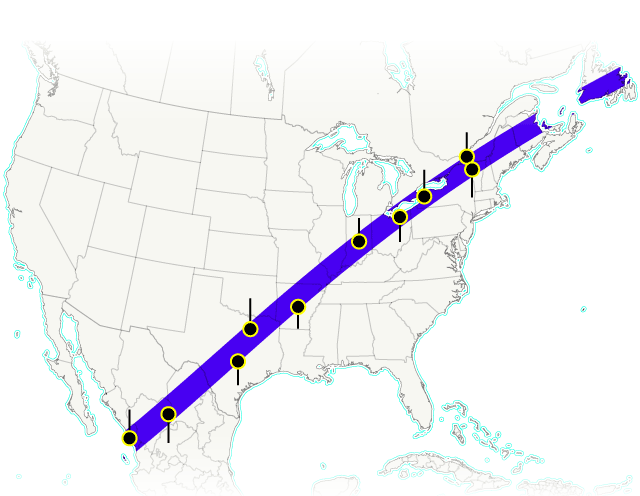
On April 8, a total solar eclipse will occur across North America, the first to be visible on the continent since the frenzy of the Great American Eclipse of 2017. This year’s event may be an even bigger tourism rush, as there won’t be another total eclipse going across such a large swath of North America until 2045. Here’s how to find the best spot to catch this rare event.
During a total eclipse, the moon completely obscures the view of the sun from Earth. The path on Earth where you’ll be able to see the full eclipse — or totality — is called the “path of totality.” This is an example of what the eclipse will look like if you’re in the path on April 8:
This might be slightly different from what you’ll see on the day of the eclipse depending on where you’ll be located. Here’s what the eclipse will look like in cities across North America, based on simulations that calculate the positions of the sun and the moon as seen from different locations on Earth.
Pacific
9:49 a.m.
Mountain
10:49 a.m.
Central
11:49 a.m.
Eastern
12:49 p.m.
Atlantic
1:49 p.m.
Note: Animations are based on simulations in Stellarium, an app that tracks positions of stars and planets to simulate views of the sky. Times are approximate.
The popularity of the 2017 eclipse drew crowds of newcomers to a phenomenon that many astronomers and seasoned eclipse chasers often prepare for years before the event.
Tora Greve, an 81-year-old artist and science fiction writer based in Sweden, has traveled to all seven continents for eclipses and has seen 24 of these events. Greve starts planning for every trip, usually with a tour group, a year or two in advance. In April, she’ll be heading to Mexico, which has lower cloud cover on average.
Searches for flights to several cities along the path have surged, according to data from Kayak. For Mazatlan, Mexico, one of the best cities to see the eclipse, the demand has increased more than tenfold year over year. Prices have also increased. After selling out a special eclipse flight going along the path of totality from Austin to Detroit, Delta added a second flight going to Detroit from Dallas.
Note: Change is for searches from Jan. 13, 2023 to Jan. 12, 2024 for travel between April 5 and April 10, 2024, compared to searches from Jan. 13, 2022 to Jan. 12, 2023 for travel between April 5 and April 10, 2023.
Source: Kayak
Little Rock, Arkansas, is expecting over 100,000 visitors, according to Jeff Chastain, the Director of Communications at the Little Rock Convention and Visitors Bureau. For a city of just over 200,000, the influx is a rare opportunity to attract new visitors.
“To be perfectly honest, most people don’t know about Little Rock,” said Chastain, who hopes the visitors will find reasons to return. He also expects the weekend to be a boon to the local economy. “If every person that comes here, if all they did was rent a hotel room, bought a tank of gas and ate out four or five times in a restaurant, maybe spend $50 or $60 on souvenirs or something like that, that’s still going to be a massive weekend for us. It’ll be unprecedented.”
Compared to other large cities in the path, those in Texas still have the most hotel rooms available to book, according to a spokesperson at Expedia, though searches for hotels in San Antonio, Austin and Dallas have all gone up year over year.
If you can’t make it to Mazatlan or Texas, consider these three criteria when deciding where to go instead: Obscuration — or how much the sun will appear to be blocked by the moon, cloudiness and duration of totality.
Here’s what these metrics will look like in Dallas, for example:
Congratulations! Albany, New York Albuquerque, New Mexico Atlanta, Georgia Austin, Texas Birmingham, Alabama Boise, Idaho Boston, Massachusetts Buffalo, New York Burlington, Vermont Calgary, Canada Charleston, West Virginia Charlotte, North Carolina Chicago, Illinois Chihuahua, Mexico Cincinnati, Ohio Ciudad Juarez, Mexico Cleveland, Ohio Columbia, South Carolina Columbus, Ohio Dallas, Texas Denver, Colorado Des Moines, Iowa Detroit, Michigan Fargo, North Dakota Guadalajara, Mexico Halifax, Canada Hermosillo, Mexico Houston, Texas Indianapolis, Indiana Jackson, Mississippi Jacksonville, Florida Kansas City, Missouri La Paz, Mexico Las Vegas, Nevada Little Rock, Arkansas Los Angeles, California Louisville, Kentucky Mazatlan, Mexico Memphis, Tennessee Miami, Florida Minneapolis, Minnesota Monterrey, Mexico Montreal, Canada Nashville, Tennessee New Orleans, Louisiana New York, New York Oklahoma City, Oklahoma Philadelphia, Pennsylvania Phoenix, Arizona Pittsburgh, Pennsylvania Portland, Oregon Quebec, Canada Raleigh, North Carolina Regina, Canada Richmond, Virginia Salt Lake City, Utah San Antonio, Texas San Francisco, California Seattle, Washington St. Louis, Missouri Tampa, Florida Tijuana, Mexico Toronto, Canada Torreon, Mexico Vancouver, Canada Washington, D.C. Winnipeg, Canada is in the path of totality. The area will see a total solar eclipse of up to 100% obscuration.
Here’s a simulated timelapse of what the sun will look like on April 8 in the city center:
Nearly all of North America will see at least a partial solar eclipse, which means the sun will appear to be partially blocked by the moon. In the path of totality, maximum obscuration of the sun is 100%. The further you are from the path, the lower the maximum obscuration will be.
Source: NASA
“A partial eclipse and a total eclipse are not comparable,” said Daniel Seaton, a solar physicist at the Southwest Research Institute. “They are fundamentally different experiences.”
Totality is the only time you’ll be able to see the sun’s corona — the outermost part of the sun’s atmosphere — which is usually hidden by the sun’s bright light. With a darkened sky, you may also see other stars, planets or even a 360-degree “sunset.”
“The animals go totally crazy,” said Greve. During an eclipse in Kenya, she saw giraffes running around and birds putting their heads under their wings. “They thought they were going to sleep.”
This year’s eclipse is also happening during a period of high solar activity. Compared to the 2017 eclipse, the sun’s corona will appear a little brighter and have more structure, said Seaton.
Perceived darkness at even 99% obscuration will look dramatically different from 100%. Kevin Reardon, an astronomer at the National Solar Observatory who travels to see eclipses as part of his solar research, likens the difference to driving within 10 miles of the Grand Canyon but not seeing the actual thing.
Another important factor to consider is cloudiness. Regions further north along the path of totality have higher average cloud cover compared to their southern counterparts.
Note: Cloudiness is a measure of average cloud cover for hourly observations in the afternoons on April 1 to 15 from 1979 to 2022, based on data from the European Centre for Medium-Range Weather Forecasts.
Source: Brian Brettschneider, NOAA
The Albany, New York Albuquerque, New Mexico Atlanta, Georgia Austin, Texas Birmingham, Alabama Boise, Idaho Boston, Massachusetts Buffalo, New York Burlington, Vermont Calgary, Canada Charleston, West Virginia Charlotte, North Carolina Chicago, Illinois Chihuahua, Mexico Cincinnati, Ohio Ciudad Juarez, Mexico Cleveland, Ohio Columbia, South Carolina Columbus, Ohio Dallas, Texas Denver, Colorado Des Moines, Iowa Detroit, Michigan Fargo, North Dakota Guadalajara, Mexico Halifax, Canada Hermosillo, Mexico Houston, Texas Indianapolis, Indiana Jackson, Mississippi Jacksonville, Florida Kansas City, Missouri La Paz, Mexico Las Vegas, Nevada Little Rock, Arkansas Los Angeles, California Louisville, Kentucky Mazatlan, Mexico Memphis, Tennessee Miami, Florida Minneapolis, Minnesota Monterrey, Mexico Montreal, Canada Nashville, Tennessee New Orleans, Louisiana New York, New York Oklahoma City, Oklahoma Philadelphia, Pennsylvania Phoenix, Arizona Pittsburgh, Pennsylvania Portland, Oregon Quebec, Canada Raleigh, North Carolina Regina, Canada Richmond, Virginia Salt Lake City, Utah San Antonio, Texas San Francisco, California Seattle, Washington St. Louis, Missouri Tampa, Florida Tijuana, Mexico Toronto, Canada Torreon, Mexico Vancouver, Canada Washington, D.C. Winnipeg, Canada area has had on average 40% to 60% cloud cover in the past four decades in mid-April.
While it’s impossible to predict cloudiness for the few hours when it will matter on the day of the eclipse, it may be advantageous to view the event from an area that has lower average cloud cover.

Higher average cloudiness
Higher
maximum
obscuration

Higher average cloudiness
Higher
maximum
obscuration

Higher average cloudiness
Higher
maximum
obscuration

Higher average cloudiness
Higher
maximum
obscuration

Higher average cloudiness
Higher
maximum
obscuration
Note: Cloudiness is a measure of average cloud cover for hourly observations in the afternoons on April 1 to 15 from 1979 to 2022, based on data from the European Centre for Medium-Range Weather Forecasts.
Sources: NASA; Brian Brettschneider, NOAA
The entire process of the moon moving across the sun’s disk will last for a couple of hours, beginning and ending with a partial eclipse. Seaton suggests looking toward the southwest, where the eclipse is coming from, to see the moon’s shadow moving toward you. Then after totality, look to the northeast to see it move away.
Totality itself will last anywhere from a few seconds to more than four minutes depending on where on the path you’re located.

Duration of
total solar eclipse

Duration of
total solar eclipse

Duration of
total solar eclipse
Source: NASA
In downtown Albany, New York Albuquerque, New Mexico Atlanta, Georgia Austin, Texas Birmingham, Alabama Boise, Idaho Boston, Massachusetts Buffalo, New York Burlington, Vermont Calgary, Canada Charleston, West Virginia Charlotte, North Carolina Chicago, Illinois Chihuahua, Mexico Cincinnati, Ohio Ciudad Juarez, Mexico Cleveland, Ohio Columbia, South Carolina Columbus, Ohio Dallas, Texas Denver, Colorado Des Moines, Iowa Detroit, Michigan Fargo, North Dakota Guadalajara, Mexico Halifax, Canada Hermosillo, Mexico Houston, Texas Indianapolis, Indiana Jackson, Mississippi Jacksonville, Florida Kansas City, Missouri La Paz, Mexico Las Vegas, Nevada Little Rock, Arkansas Los Angeles, California Louisville, Kentucky Mazatlan, Mexico Memphis, Tennessee Miami, Florida Minneapolis, Minnesota Monterrey, Mexico Montreal, Canada Nashville, Tennessee New Orleans, Louisiana New York, New York Oklahoma City, Oklahoma Philadelphia, Pennsylvania Phoenix, Arizona Pittsburgh, Pennsylvania Portland, Oregon Quebec, Canada Raleigh, North Carolina Regina, Canada Richmond, Virginia Salt Lake City, Utah San Antonio, Texas San Francisco, California Seattle, Washington St. Louis, Missouri Tampa, Florida Tijuana, Mexico Toronto, Canada Torreon, Mexico Vancouver, Canada Washington, D.C. Winnipeg, Canada , the total solar eclipse will last about 3.5 minutes.
The area where the maximum eclipse will last more than four minutes stretches through Mexico and into Texas, Arkansas, Missouri, Illinois and Indiana, though the area shrinks as you move farther north along the path of totality. In Newfoundland, the northernmost part of the path, totality will last only about three minutes at most.
Throughout the path, the duration of totality will also be longer as you move closer to the center.
Andrew Sullivan, a lawyer based in New York, will be going to nearby Vermont on his third eclipse trip. Taking a chance on cloudiness for a closer location to home, he’s maximizing duration instead by finding lodging near the centerline.
“It’s a difference of 10, 15 seconds at least, which seems worthwhile if you can get it,” he said. Sullivan booked his trip in February as he saw availability dwindling in ideal locations.
The sliver of land where totality will be longer than four minutes is widest in Mazatlan.
Source: NASA
If you still want to plan a trip to catch totality, here’s what the eclipse experience will be like in other cities:
Albany, New York Albuquerque, New Mexico Atlanta, Georgia Austin, Texas Birmingham, Alabama Boise, Idaho Boston, Massachusetts Buffalo, New York Burlington, Vermont Calgary, Canada Charleston, West Virginia Charlotte, North Carolina Chicago, Illinois Chihuahua, Mexico Cincinnati, Ohio Ciudad Juarez, Mexico Cleveland, Ohio Columbia, South Carolina Columbus, Ohio Dallas, Texas Denver, Colorado Des Moines, Iowa Detroit, Michigan Fargo, North Dakota Guadalajara, Mexico Halifax, Canada Hermosillo, Mexico Houston, Texas Indianapolis, Indiana Jackson, Mississippi Jacksonville, Florida Kansas City, Missouri La Paz, Mexico Las Vegas, Nevada Little Rock, Arkansas Los Angeles, California Louisville, Kentucky Mazatlan, Mexico Memphis, Tennessee Miami, Florida Minneapolis, Minnesota Monterrey, Mexico Montreal, Canada Nashville, Tennessee New Orleans, Louisiana New York, New York Oklahoma City, Oklahoma Philadelphia, Pennsylvania Phoenix, Arizona Pittsburgh, Pennsylvania Portland, Oregon Quebec, Canada Raleigh, North Carolina Regina, Canada Richmond, Virginia Salt Lake City, Utah San Antonio, Texas San Francisco, California Seattle, Washington St. Louis, Missouri Tampa, Florida Tijuana, Mexico Toronto, Canada Torreon, Mexico Vancouver, Canada Washington, D.C. Winnipeg, Canada
Congratulations! Dallas is in the path of totality. It’s one of the best cities to see the total solar eclipse.
In the city center, the partial eclipse will begin at approximately 12:23 p.m. local time. Totality will begin at around 1:40 p.m. and last about 3.5 minutes.
The area has had on average 40% to 60% cloud cover in the past four decades for mid-April. Mazatlan, an even better location with lower average cloudiness, is about 900 miles away.
“It’s like nothing else you can experience without traveling to another place in the solar system,” said Seaton. “Very few people in the history of humanity have had the opportunity to experience this. Don’t you want to be one of them?”
Sources: NASA; Brian Brettschneider, NOAA; Eclipse2024.org; Xavier M. Jubier; Stellarium
With assistance by: Nikki Ekstein Editors: Alex Tribou Nicole Flatow






+ There are no comments
Add yours